

Melanoma Explained: Stages, Treatment Options and What Comes Next
Melanoma starts in melanocytes, the cells that give skin its colour. The disease is less common than other skin cancers but more likely to spread if it is left alone. The diagnosis covers a wide range, from a thin lesion removed in one short operation to advanced disease treated with drugs that retrain the immune system, and the stage of the melanoma explains almost every decision that follows.
How Melanoma Is Diagnosed and Confirmed
Most melanomas are found as a new mole or a change in an existing one, usually noticed by the patient or someone close to them. A concerned GP will refer you to a dermatologist, who examines the lesion under magnification. A diagnosis cannot be made from the surface alone, so the suspicious area is removed whole in a procedure called an excision biopsy and sent to a pathologist.
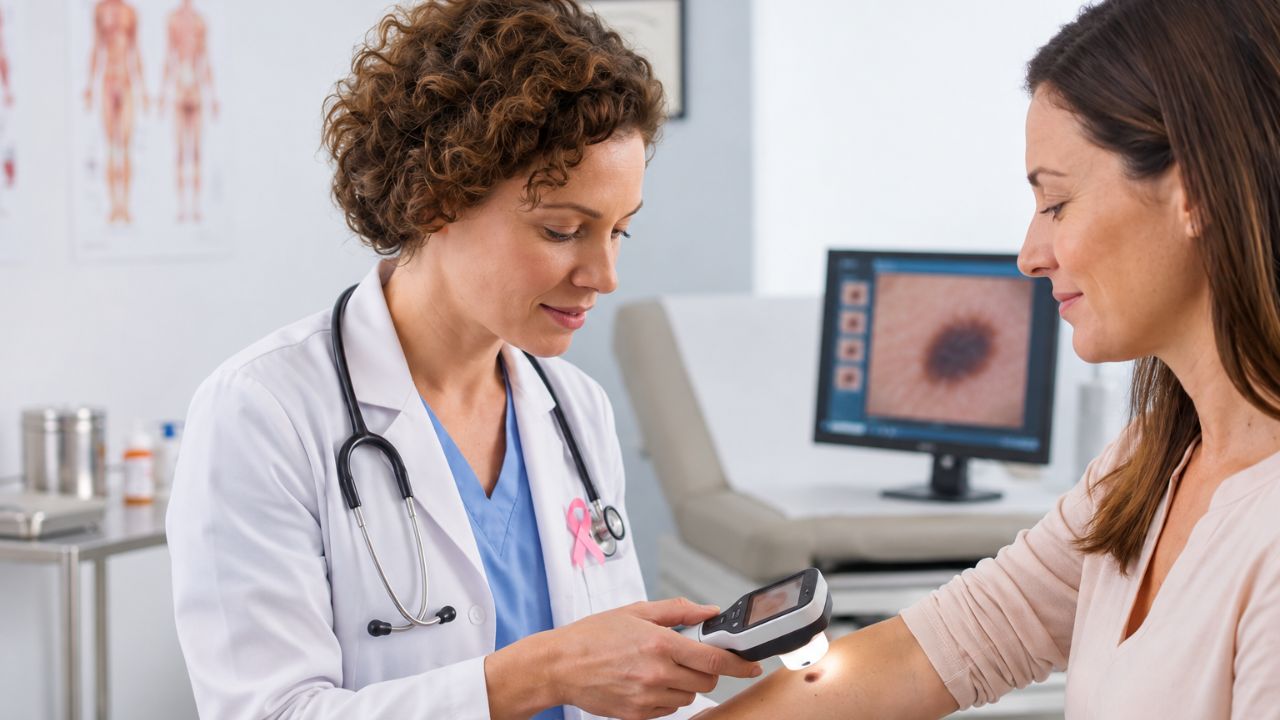
Dermatologists use a handheld dermatoscope, a lit magnifier that shows pigment patterns beneath the surface, and a thorough appointment includes a full skin examination because melanomas can sit in places the patient has never looked.
The pathology report matters because it measures how deeply the melanoma has grown into the skin, and that depth drives the plan. For most people, melanoma skin cancer treatment begins with a wider operation to remove the biopsy scar together with a margin of healthy skin, which lowers the chance of the cancer coming back.
Understanding Melanoma Stages and Survival Rates
Stage describes how deeply the melanoma has grown, whether it has reached the lymph nodes and whether it has spread to distant organs. Doctors use stages 0 to 4, and stage 0 means the abnormal cells are confined to the top layer of skin. Stages 1 and 2 are separated mainly by tumour thickness and whether the surface has broken down, stage 3 means the melanoma has reached nearby lymph nodes or produced deposits in the skin close to the original site, and stage 4 means it has travelled to distant organs such as the lungs, liver or brain.
Cancer Research UK’s survival figures for England show that almost everyone with stage 1 melanoma survives their cancer for five years or more, around 85 in 100 people with stage 2 do so, and almost 75 in 100 with stage 3 do so. Across all stages, around 95 in 100 adults with melanoma in the UK live at least five years after diagnosis.
Those numbers describe groups of people, not individuals, and age, the position of the tumour and general health all move a personal outlook up or down. Women tend to do better than men, possibly because they see a doctor earlier.
Stage 4 has no figure in the same format. Modern immunotherapy has changed outcomes faster than registry data can follow, so the older statistics do not describe people treated with today’s drugs.
Surgical Treatment and Lymph Node Assessment for Early Melanoma
Surgery is the main treatment for melanoma, and for early disease it is often the only one. The width of the margin taken around the original site depends on the thickness of the tumour, with thicker melanomas needing a wider rim of normal skin. Most wide excisions are done under local anaesthetic, and larger defects may need a skin graft or a flap of nearby skin to close.
For melanomas above a certain thickness, a surgeon may also offer a sentinel lymph node biopsy. A tracer is injected near the scar, the first lymph node that drains the area is identified and removed, and a pathologist checks it for cancer cells. A clear node is reassuring, while a positive one changes the stage and opens the discussion about further treatment.
The operation is usually a day case. Stitches either dissolve or are removed within a couple of weeks, and the surgeon will advise on avoiding strain on the wound while it heals, particularly on the back or over joints, where tension can widen the scar. For higher-risk stage 2 melanoma and for stage 3 melanoma that has been fully removed, drug treatment after surgery may be offered to lower the chance of recurrence, and the choice of drug depends partly on genetic testing of the tumour.
Treatment Options for Advanced Stage 3 and Stage 4 Melanoma
Advanced melanoma is now treated mostly with drugs. Immunotherapy medicines such as nivolumab and ipilimumab release the brakes on the immune system so that it attacks the tumour. Tissue from the melanoma is also tested for changes in the BRAF gene, because targeted tablets exist for tumours that carry the V600 alteration, and they can shrink a tumour quickly.
A worldwide study of 945 people with stage 3 or 4 melanoma followed them for six and a half years after treatment. Among those given nivolumab with ipilimumab, more than 55 in 100 people with BRAF-positive melanoma and around 45 in 100 with BRAF-negative melanoma were still alive at that point. Responses vary, and some patients can stop treatment and remain well for years.
Immunotherapy can take weeks to show its effect, and scans are repeated at set intervals so that the team can judge how the melanoma is responding. Decisions for stage 4 disease are made by a multidisciplinary team of oncologists, surgeons, radiologists and specialist nurses, and melanoma that has reached the brain is often treated with tightly focused radiotherapy, known as stereotactic radiosurgery, alongside drug treatment. Radiotherapy has a smaller role elsewhere in the body, usually to shrink a large tumour or relieve symptoms. Immunotherapy can inflame healthy organs including the bowel, skin, liver and thyroid, so patients are monitored closely and told which symptoms warrant a same-day call to the team.
Melanoma Follow-Up Care, Skin Checks and Recurrence Monitoring
Follow-up depends on stage. Someone treated for a thin melanoma may have a few skin checks over the following years, while a person with stage 3 disease usually attends more often and may have scans. Each visit includes a full skin examination and a feel of the lymph nodes, because a person who has had one melanoma has a higher chance of developing another.
Between appointments, a monthly check at home with a mirror, or with help for the back and scalp, is the habit that picks up changes early. Photographs taken in the same light make comparison easier. Any new mark, or any change in the old scar or the skin around it, belongs in a call to the clinic rather than a wait-and-see approach.
Protection from sun and sunbeds remains sensible after treatment, since ultraviolet light is the main cause of melanoma. Patients on immunotherapy may be advised to take extra care with their skin and to report rashes early.